Kimchi Coding becomes the first coding agent to integrate MiniMax M3
We added MiniMax M3 to the recipe. Kimchi Coding just got spicier!
We're the first coding agent in the world to make MiniMax M3 available, which is rolling out right now with Early Access.
Kimchi Coding includes a smart and autonomous multi-model harness obsessed with token optimization. Its model orchestration engine routes each task to the best-fit model based on complexity and cost, reserving frontier models for the hardest evaluations while other open-weight models handle the bulk of the work.
Our coding agent scores the generated code and runs continuous feedback loops, so output stays accurate while token use is optimized at every step, which is what makes Kimchi both more accurate and more cost-efficient than relying on a single commercial model.
Why the builder matters
When you hand a task to Kimchi Coding, the orchestrator classifies and delegates. Planning phases go to the planner. File reads go to the explorer. But the actual work, arguably the most important aspect of the coding experience, goes to the builder. It's where most tokens are spent and where model quality has the greatest impact.
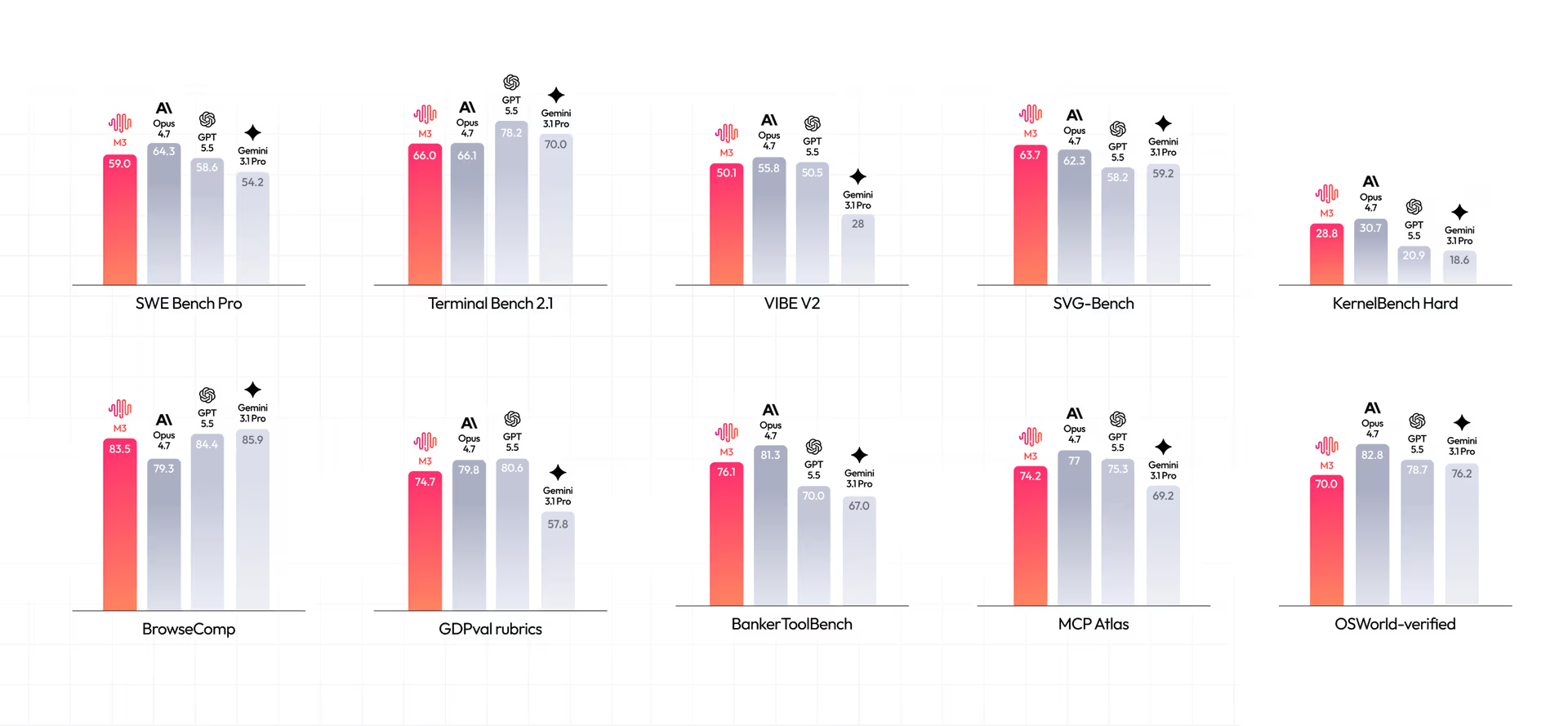
M3 scores 59.0% on the SWE-bench Pro, which is the benchmark that uses real GitHub issues rather than toy problems. That puts it ahead of GPT-5.5 and Gemini 3.1 Pro on the same benchmark.
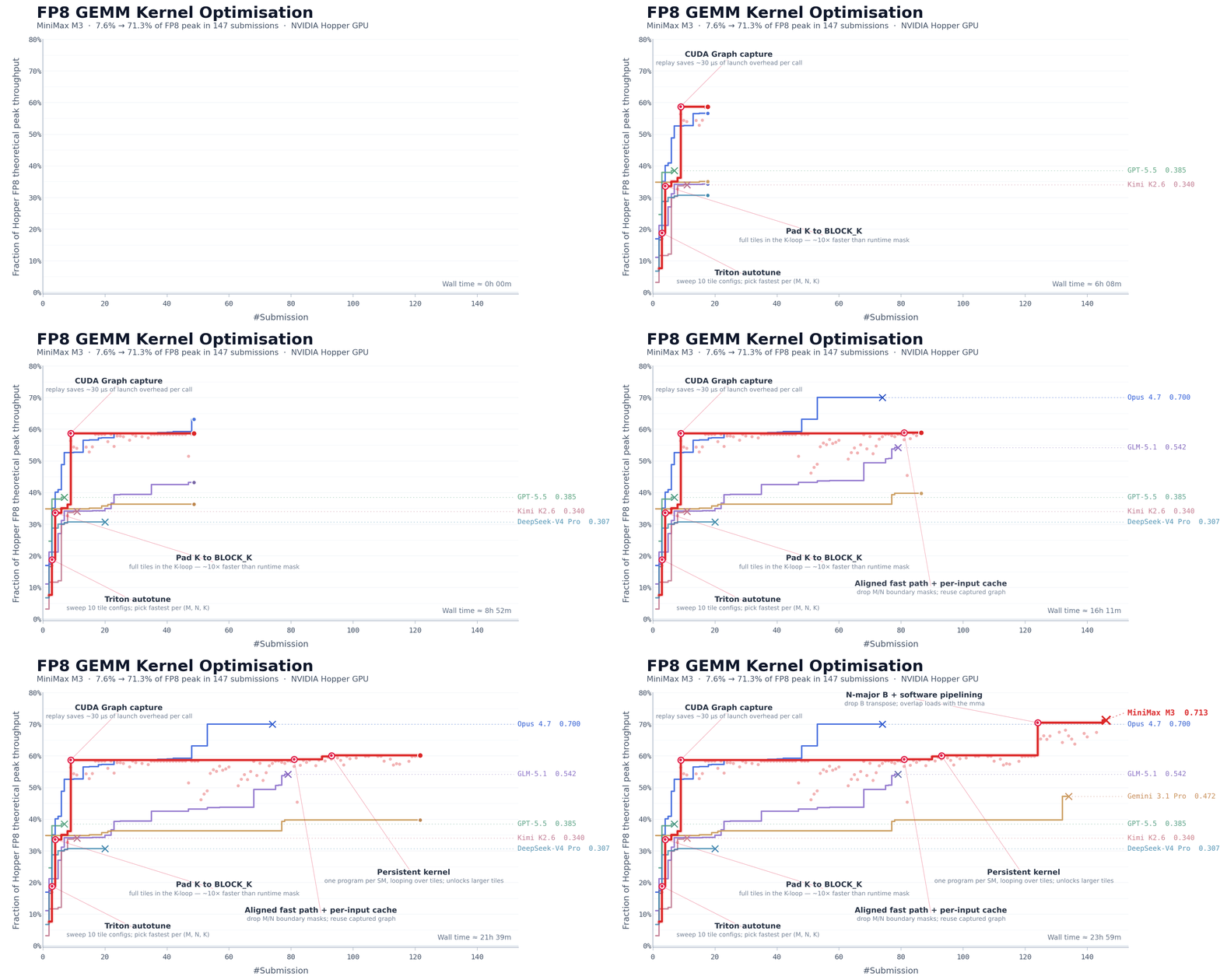
MiniMax highlights M3's ability to keep making progress over extended autonomous runs. In a CUDA kernel optimization task, M3 ran for about 24 hours, made 147 benchmark submissions, used 1,959 tool calls, and kept improving after long performance plateaus.
The context window is actually usable
M3 has a 1-million token context window, which on its own is not uncommon, but what's exciting is the new MSA - MiniMax Sparse Attention - the architecture that makes the window very fast.
The 1M-token context window has a guaranteed minimum of 512K tokens and preserves practical latency and throughput at extreme context lengths.
Per-token compute at 1M context is 1/20th of what Minimax M2.7 required at that length. Decoding is 15 times faster.
/ferment got a big upgrade
/ferment is Kimchi Coding's vision for a more autonomous SDLC. Give it a task, and it breaks it into subtasks, selects the right model for each, and delivers a finished result with no human intervention.
For /ferment sessions, this matters. Long-running projects accumulate context fast. The dashboard warns you at 50+ turns to run /compact because model quality tends to degrade. With M3 as the builder, you get more headroom before that happens.
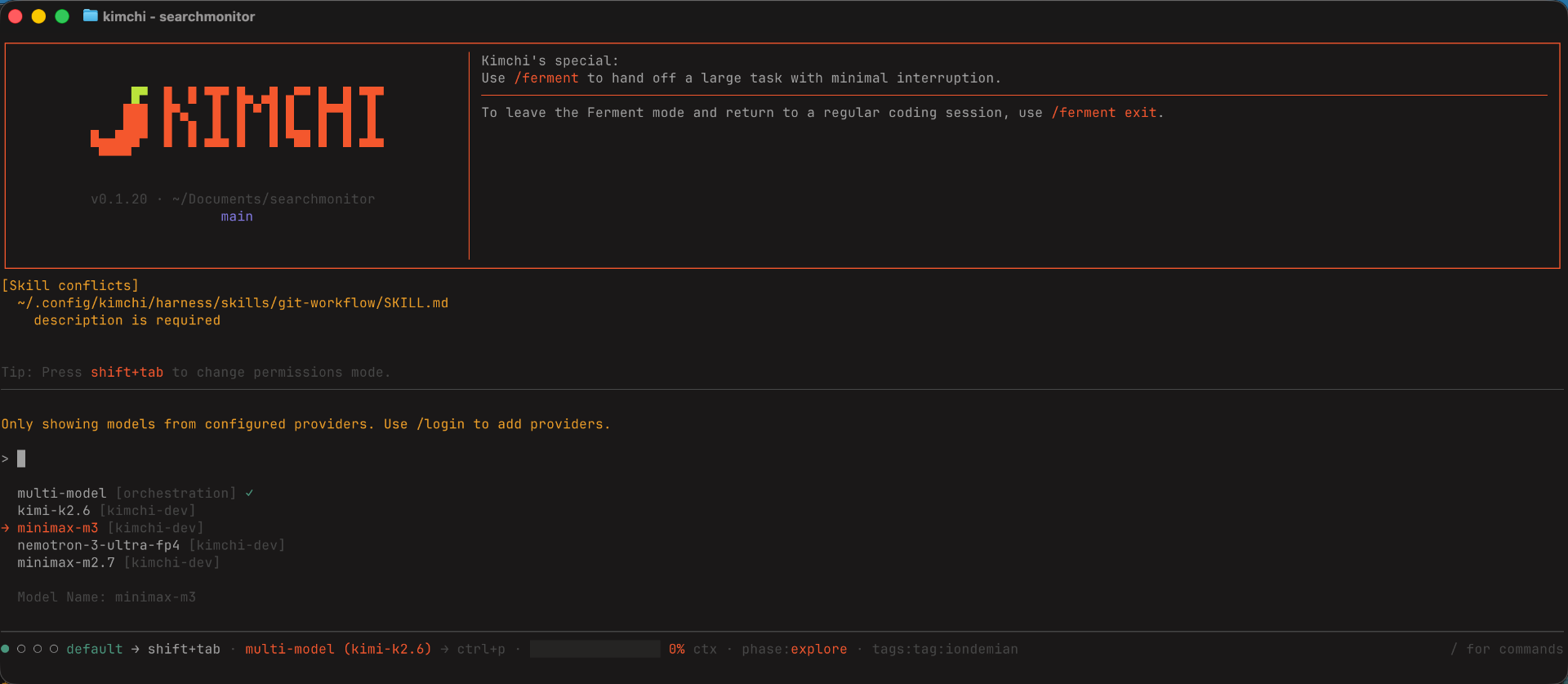
For large codebases where a single /ferment phase needs to reason across many files, the practical context ceiling just went up considerably.
During a /ferment session, builder subagents are spawned to execute each step. Each agent running the M3 is going to be 15x faster in decoding at full context, meaning that the build phases are going to be completed much faster.
The speed difference compounds exponentially when taking into account the parallel agent capabilities of Kimchi.
We're fermenting something bigger. M3 is just the latest ingredient that is set to make Kimchi Coding the leading coding agent in the industry.
Access to MiniMax M3 is rolling out in phases. Join here, and we'll let you know when it goes live on your account.