Kimchi Coding is GA, and why we built it
Today we take Kimchi Coding out of Early Access. It's live at kimchi.dev with full production support behind it — and this is the story of why we built it.
Today we take Kimchi Coding out of Early Access. It's live at kimchi.dev with full production support behind it.
Before the feature list, I want to tell you why this product exists, because that reason is personal.
The bill that made me angry
Six months ago, I watched an engineering leader at a company I respect show me their AI coding spend. It was growing faster than their headcount. Every task, including trivial refactors that a small model handles perfectly well, was going to the most expensive frontier model on the market. They knew it was wasteful. They had no way to fix it without hiring someone to babysit model selection all day.
This is not an outlier. This is the default setup everywhere, and it's broken.
The smartest enterprises already route around it by hand. Frontier models for the hardest problems, open-weight models for the bulk of the work. What nobody had was the machinery to do this automatically, with quality checks. So we built it.
And on the way, we built something bigger: an inference cloud. Because here is what we learned. Routing is only half the answer. Whoever controls inference controls token cost. If your open-weight models run on someone else's marked-up API, your savings leak out through their margin. So we run inference ourselves, on Cast AI core technology, using the entirety of our Kubernetes optimization engine with fully autonomous GPU management. We were the first to release MiniMax M3 on our inference cloud, running at scale within hours, back in early June.
We added the best open-weight and open-source models, some on par with frontier models. We added support for closed commercial models too. Today Kimchi runs kimi-k2.7, glm-5.2, deepseek-v4-flash, minimax-m3 and nemotron-3-ultra.
And we got a lot of B300s to run them. A lot of them. With great partners that I admire.
We made it with full data sovereignty, so your code never leaves your space. We made a self-hosted version so it runs inside your own VPC.
You need to try it… kimchi.dev
What Kimchi does
Kimchi is an autonomous multi-model coding agent. The orchestration engine routes every task to the best-fit model on complexity and cost. Feedback loops score the code at each step and cut token waste before it compounds.
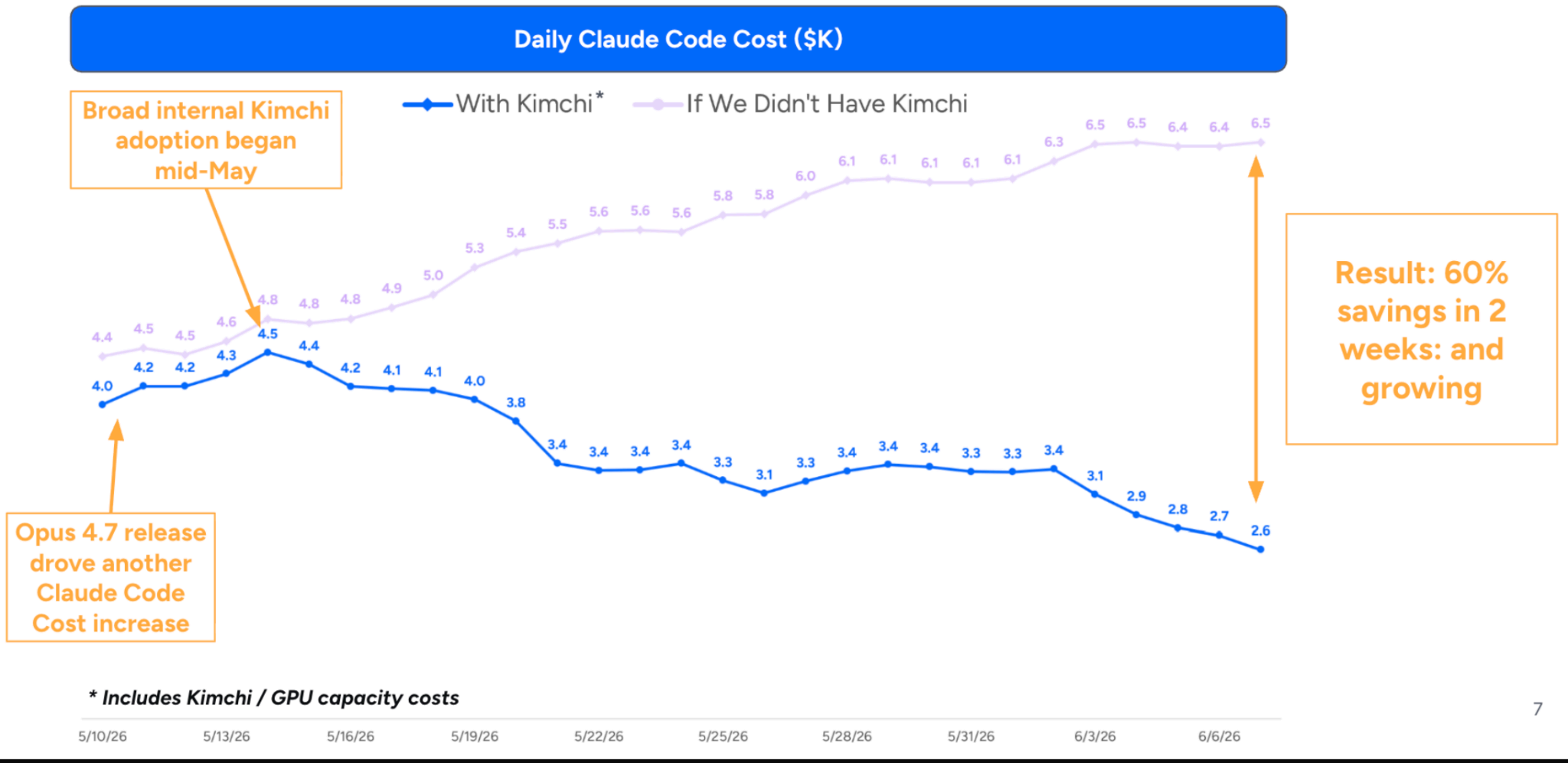
In shadow-mode evals against a commercial-models-only baseline, Kimchi came out 2.5x cheaper with equal or better spec-match and test-pass rates. I don't expect you to take my word for it. Bring your own workloads and check.
Where does the 2.5x come from? Routing pushes most work to open-weight models, and inference runs self-hosted on GPU infrastructure that Cast AI optimizes down to the node. We spent six years squeezing waste out of Kubernetes and GPU compute for BMW, HuggingFace, and many others. Kimchi is that engine pointed at AI coding.
These are our own results, on more than 150 Cast AI developers:
GA also ships with two things I'm particularly attached to.
Ferment is our project engine. You don't give it a task, you give it a project. Ferment breaks it into phases, grades them, and runs the independent ones in parallel across multiple agent sessions, each phase routed to whatever model fits. Most agents today take a function and give you back a function. Ferment takes a milestone. And yes, we named it after what happens to good kimchi when you give it time and the right conditions.
Teleport moves your session off your laptop and into a cloud sandbox on our (or your) infrastructure. Start a long job in the office, close the laptop, and the agents keep working. You reconnect from wherever you are and the session is further along than when you left it.
Governance is in the product because I got the calls
I've heard the story too many times: an agent loops all night on a bad plan and someone wakes up to a five-figure invoice. So Kimchi ships with hard spend caps from a single API key up to the whole organization. Runaway loops terminate on their own. A real-time FinOps dashboard shows which developer and which project spent what, down to the token.
Your code stays inside your perimeter
Data sovereignty stopped being negotiable for enterprises a while ago. Kimchi is ISO 27001 and SOC 2 Type II certified, GDPR compliant, and runs standalone in your own VPC or on dedicated Nvidia B300 GPUs on Cast AI's inference infrastructure. Your code never leaves your control. This was a design constraint from day one, not a compliance retrofit.
What Akamai says
"Kimchi is fundamentally changing how our engineering team thinks about AI-assisted development. The multi-model approach keeps the quality of a single frontier model while cutting token costs dramatically. And the governance suite is the best we've seen in the market. Data sovereignty, cost observability, and budget control in one place. For an organization like Akamai, that makes a real difference."
— Dekel Shavit, Senior Director of Engineering, Akamai
What GA means
It means enterprises run Kimchi in production today and the 2.5x holds on their code, not just our evals. Try it at kimchi.dev. When the first invoice arrives, show it to your CFO. That conversation goes very differently now.
Thank you to my team, to our customers, and to our investors. The journey was long, but I can tell you that it was worth it.
Happy coding. From today, tokens are cheaper.
From the road
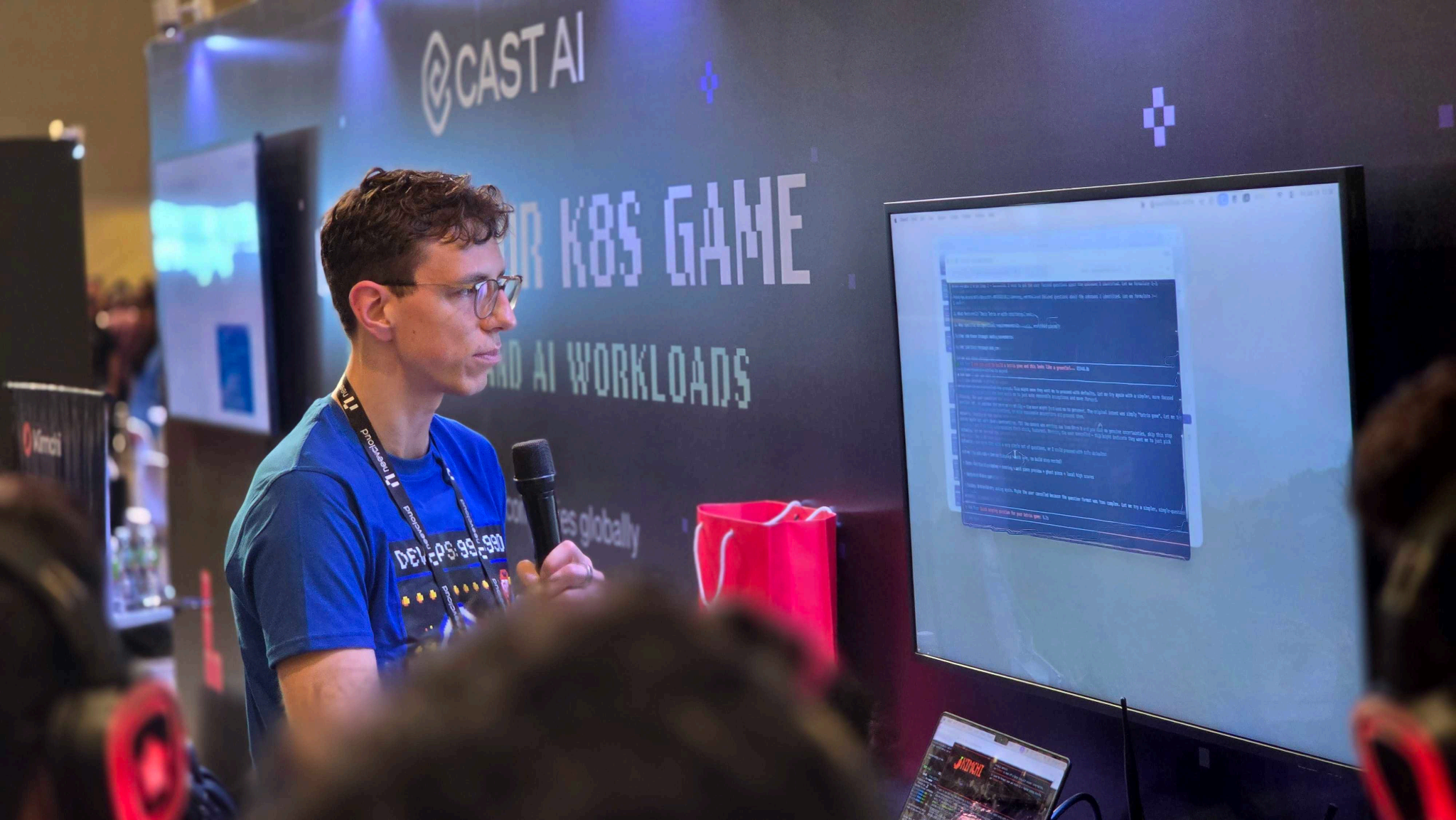
Kimchi at the Cast AI booth — live demo on the show floor